Note
Go to the end to download the full example code.
ITCFT Impact of noise
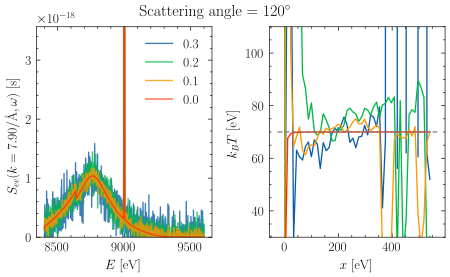
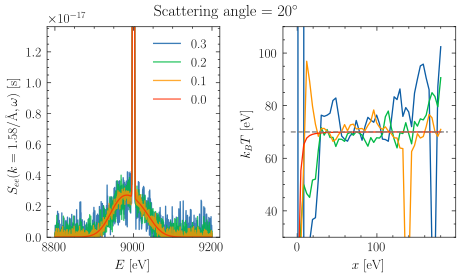
In this example, we apply the ITCFT to increasingly noisy data with different scattering angles.
import jax
import matplotlib.pyplot as plt
import scienceplots  # noqa: F401
from jax import numpy as jnp
from jax import random
from jpu import numpy as jnpu

import jaxrts

ureg = jaxrts.ureg

plt.style.use("science")

state = jaxrts.PlasmaState(
    ions=[jaxrts.Element("C")],
    Z_free=jnp.array([3]),
    mass_density=jnp.array([1]) * ureg.gram / ureg.centimeter**3,
    T_e=70 * ureg.electron_volt / ureg.k_B,
)

state["screening length"] = jaxrts.models.ArbitraryDegeneracyScreeningLength()
state["screening"] = jaxrts.models.LinearResponseScreening()
state["ionic scattering"] = jaxrts.models.OnePotentialHNCIonFeat()
state["free-free scattering"] = jaxrts.models.RPA_DandreaFit()
state["bound-free scattering"] = jaxrts.models.SchumacherImpulse()
state["free-bound scattering"] = jaxrts.models.DetailedBalance()

for angle, e_range in [[120, 600], [20, 200]]:
    setup = jaxrts.Setup(
        scattering_angle=ureg(f"{angle}°"),
        energy=ureg("9000 eV"),
        measured_energy=ureg("9000 eV")
        + jnp.linspace(-e_range, e_range, 1000) * ureg.electron_volt,
        instrument=jaxrts.instrument_function.Gaussian(fwhm=ureg("3.0eV")),
    )

    # Turn off the dispersion correction
    setup.correct_k_dispersion = False

    S_ee = state.probe(setup)

    fig, ax = plt.subplots(1, 2, figsize=(5, 3))

    # Add some noise
    sigma_rel = [0.0, 0.1, 0.2, 0.3]
    RNGKey = random.PRNGKey(123456789 * angle)
    noise_seed = random.normal(
        RNGKey,
        (
            len(sigma_rel),
            len(setup.measured_energy),
        ),
    )

    for i, sigma in enumerate(sigma_rel[::-1]):
        noise_norm = jnpu.max(
            state["free-free scattering"].evaluate_raw(state, setup)
        )
        noise = noise_seed[i, :] * sigma * noise_norm
        S_ee_noise = S_ee + noise

        ax[0].plot(
            setup.measured_energy.m_as(ureg.electron_volt),
            S_ee_noise.m_as(ureg.second),
            alpha=0.8,
            color=f"C{i}",
            label=sigma,
        )

        x = jnp.linspace(1, 0.9 * e_range) * ureg.electron_volt

        T_auto = jax.vmap(
            jaxrts.analysis.ITCFT,
            in_axes=(None, None, None, 0),
            out_axes=(0),
        )(S_ee_noise, ureg("60/keV"), setup, x)

        ax[1].plot(
            x.m_as(ureg.electron_volt),
            (T_auto * ureg.k_B).m_as(ureg.electron_volt),
            color=f"C{i}",
            ls="solid",
        )
    ax[0].set_ylim(jnp.array([0, 5 * noise_norm.m_as(ureg.second)]))
    ax[1].set_ylim(
        jnp.array([-40, 40]) + (state.T_e * ureg.k_B).m_as(ureg.electron_volt)
    )
    ax[1].hlines(
        [(state.T_e * ureg.k_B).m_as(ureg.electron_volt)],
        *ax[1].get_xlim(),
        color="gray",
        ls="dashed",
    )

    ax[1].set_ylabel("$k_B T$ [eV]")
    ax[0].set_ylabel(
        f"$S_{{ee}}(k={setup.k.m_as(1 / ureg.angstrom):.2f}/$\\AA$, \\omega)$ [s]"  # noqa: E501
    )
    ax[1].set_xlabel("$x$ [eV]")
    ax[0].set_xlabel("$E$ [eV]")
    ax[0].legend()
    fig.tight_layout()
    fig.suptitle(f"Scattering angle = ${angle}^\\circ$")

plt.show()
Total running time of the script: (0 minutes 20.400 seconds)