Note
Go to the end to download the full example code.
Imaginary time correlation function thermometry
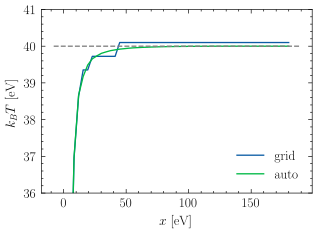
This example showcases how apply the analysis functions to get temperatures from the Laplace transform of the structure, as proposed by [Dornheim et al., 2022].
import jax
import matplotlib.pyplot as plt
from jax import numpy as jnp
from jpu import numpy as jnpu

import jaxrts

ureg = jaxrts.ureg

plt.style.use("science")

state = jaxrts.PlasmaState(
    ions=[jaxrts.Element("C")],
    Z_free=jnp.array([3]),
    mass_density=jnp.array([1]) * ureg.gram / ureg.centimeter**3,
    T_e=40 * ureg.electron_volt / ureg.k_B,
)
setup = jaxrts.Setup(
    scattering_angle=ureg("30°"),
    energy=ureg("9000 eV"),
    measured_energy=ureg("9000 eV")
    + jnp.linspace(-200, 200, 500) * ureg.electron_volt,
    instrument=jaxrts.instrument_function.Gaussian(fwhm=ureg("3.0eV")),
)

# Turn off the dispersion correction
setup.correct_k_dispersion = False

state["screening length"] = jaxrts.models.ArbitraryDegeneracyScreeningLength()
state["screening"] = jaxrts.models.LinearResponseScreening()
state["ionic scattering"] = jaxrts.models.OnePotentialHNCIonFeat()
state["free-free scattering"] = jaxrts.models.RPA_DandreaFit()
state["bound-free scattering"] = jaxrts.models.SchumacherImpulse()
state["free-bound scattering"] = jaxrts.models.DetailedBalance()


S_ee = state.probe(setup)

# We compare two approaches, the default minimization finding with the more
# forward grid finding
tau = jnp.linspace(1, 60, 500) / (1 * ureg.kiloelectron_volt)

# x is the cut-off Energy
x = jnp.linspace(1, 180) * ureg.electron_volt

T_grid, L_grid = jax.vmap(
    jaxrts.analysis.ITCFT_grid, in_axes=(None, None, None, 0), out_axes=(0, 1)
)(S_ee, tau, setup, x)

T_auto = jax.vmap(
    jaxrts.analysis.ITCFT,
    in_axes=(None, None, None, 0),
    out_axes=(0),
)(S_ee, jnpu.max(tau), setup, x)

fig, ax = plt.subplots()
ax.plot(
    x.m_as(ureg.electron_volt),
    (T_grid * ureg.k_B).m_as(ureg.electron_volt),
    label="grid",
)
ax.plot(
    x.m_as(ureg.electron_volt),
    (T_auto * ureg.k_B).m_as(ureg.electron_volt),
    label="auto",
)
ax.set_ylim(
    jnp.array([-4, 1]) + (state.T_e * ureg.k_B).m_as(ureg.electron_volt)
)
ax.hlines(
    [(state.T_e * ureg.k_B).m_as(ureg.electron_volt)],
    *ax.get_xlim(),
    color="gray",
    ls="dashed",
)

ax.set_ylabel("$k_B T$ [eV]")
ax.set_xlabel("$x$ [eV]")
ax.legend()
fig.tight_layout()

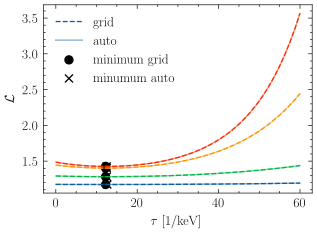
# Plot different Laplace-Transforms for both methods.
fig, ax = plt.subplots()

E_shift = -(setup.measured_energy - setup.energy)
instrument = setup.instrument(-E_shift / (1 * ureg.hbar))
for i, x in enumerate([20, 40, 80, 120]):
    minimizer = jaxrts.analysis.ITCF(
        S_ee, E_shift, instrument, E_shift, ureg(f"{x}eV"), raw=False
    )

    T_auto = minimizer.get_T(60 / (1 * ureg.kiloelectron_volt))
    tau = jnp.linspace(1e-8, 60)
    L_auto = [minimizer(t * (1 / ureg.kiloelectron_volt)) for t in tau]
    T_grid, L_grid = jaxrts.analysis.ITCFT_grid(
        S_ee, tau / (1 * ureg.kiloelectron_volt), setup, ureg(f"{x}eV")
    )
    ax.plot(
        tau,
        L_auto,
        ls="dashed",
        color=f"C{i}",
        label="grid" if i == 0 else None,
    )
    ax.plot(
        tau,
        L_grid.m_as(ureg.dimensionless),
        ls="solid",
        color=f"C{i}",
        alpha=0.5,
        label="auto" if i == 0 else None,
    )
    ax.scatter(
        [0.5 / (T_grid * ureg.k_B).m_as(ureg.kiloelectron_volt)],
        [jnpu.min(L_grid).m_as(ureg.dimensionless)],
        color="black",
        label="minimum grid" if i == 0 else None,
    )
    ax.scatter(
        [0.5 / (T_auto * ureg.k_B).m_as(ureg.kiloelectron_volt)],
        [jnpu.min(L_grid).m_as(ureg.dimensionless)],
        color="black",
        marker="x",
        label="minumum auto" if i == 0 else None,
    )

ax.set_xlabel("$\\tau$ [1/keV]")
ax.set_ylabel("$\\mathcal{L}$")
ax.legend()

fig.tight_layout()
plt.show()
Total running time of the script: (0 minutes 14.783 seconds)