Hypernetted Chain
The calculation of the ion-ion static structure using hypernetted chain (HNC) calculations can provide good agreement with more costly techniques if adequate potentials are chosen [Fletcher et al., 2015, Wünsch et al., 2009].
It allows for obtaining pair distribution functions \(g_{ab} = 1 + h_{ab}\) by iteratively solving the Ornstein Zernike equation of a classical liquid, splitting it into a direct correlation function \(c_{\text{ab}}\) and an indirect term.
and closing it with the HNC approximation, where \(V_\text{ab}\) are the potentials between particles \(a\) and \(b\).
Structure factors can the be calculated via
Our implementation is based on the work of Kathrin Wünsch [Wünsch, 2011]. See especially the flowchart in Figure 4.1 therein, and also [Schumacher et al., 2025] and [Shaffer et al., 2017].
Within the HNC modules, all quantities have three axis with \((n\times n \times m)\) entries, where \(n\) is the number of ion species considered and \(m\) is the number of \(r\) or \(k\) points considered.
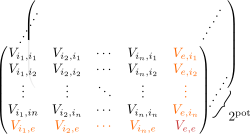
The HNC approach is capable of incorporating electrons, natively, by adding it
as an additional ion species. This is normally achieved by setting
jaxrts.hnc_potentials.HNCPotential.include_electrons to
"SpinAverged".
This adds one additional entry to the first two dimensions (see figure above).
If a user requires to separate two kinds of electrons for their different
spins, set jaxrts.hnc_potentials.HNCPotential.include_electrons to
"SpinSeparated". This will introduce two additional entries, instead, with
half of the electron density for each of them.