Physics
XRTS is describing the scattering of an X-ray photon on electrons. In the WDM community, the term summarizes Raman, Rayleigh and Thomson scattering processes [Glenzer and Redmer, 2009].
In a typical setup, a light-source provides photons carying momentum \(\hbar\vec{k_0}\) and energy \(\hbar\omega_0\). This light scatteres off a target, often a WDM or plasma state, defined by a set of plasma paramters, such as density, temperature, and ionization. A detector, located at an angle \(\theta\) collects scattered photons, with energy \(\hbar\omega_s\), and momentum \(\hbar\vec{k}_s\). The transferred quantities shall be denoted with \(\vec{k}\) (the scattering vector) and \(\omega\) (photon frequency shift).
Since the plasma is isotropic, we simplify that only the absolute value of the scattering vector \(\vec{k}\) has to be considered. This quantity can be expressed as
where the approximation holds when \(k\) is small compared to \(k_0\). A sketch of the geometry of a typical XRTS experiment can be seen in the figure.
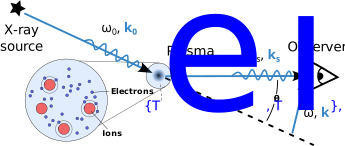
An actual XRTS signal arises from several distinct mechanisms that are interpreted according to the chemical picture introduced by Chihara [Chihara, 2000]. In this model, and in jaxrts, the total electron–electron dynamic structure factor is decomposed into a sum of contributions that correspond to different physical origins—namely, elastic (el), free–free (ff), bound–free (bf), and free–bound (fb) interactions between electrons and ions.
Each of these four contributions have to be defined, in order to generate a spectrum. See Generating a first spectrum on how this is done. A comprehensive list of available models can be found under Models implemented.
\(S_{ee}^{\text{tot}}\) is related to the intensity \(I\) measured in an experiment via:
Here, \(R\) is the combined source instrument function
(jaxrts.setup.Setup.instrument), \(\circledast\) is the
convolution, and the exponent \(\nu\) accounts for the frequency
redistrubution correction (jaxrts.setup.Setup.frc_exponent, see
[Crowley and Gregori, 2013].