Note
Go to the end to download the full example code.
Number of interpolation in the Born Mermin Chapman Interpolation
The Chapman Interpolation of the Born Mermin approximation saves computation time by evaluating the Structure factor not on all frequencies, but only on a given number of points, and interpolates after. This example is investigating the required number of points for the interpolation.
We also compare the number of points required when solving the integral for the
imaginary part of the collision frequency, or connecting it via a Kramers
Kronig relation (KKT = True). We observe that the number of grid-points has
to be higher for comparable quality of the result, when using KKT.
Note
The time printed in this script is the time after the first compilation (which normally takes a notable time).
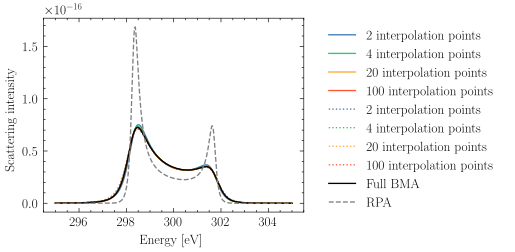
Full BMA: 7.653336524963379s
2 interp points: 0.3213319778442383s       Mean deviation from full RPA:  -1.4351313579323623e-19 Max deviation from full RPA:  8.319787759235588e-18
4 interp points: 0.34596920013427734s       Mean deviation from full RPA:  1.432086737341146e-19 Max deviation from full RPA:  3.195834972902572e-18
20 interp points: 0.5202808380126953s       Mean deviation from full RPA:  -5.753141295085147e-20 Max deviation from full RPA:  6.357993605171434e-19
100 interp points: 1.493440866470337s       Mean deviation from full RPA:  -6.033247204606144e-20 Max deviation from full RPA:  5.837565928545203e-19
2 interp points: 0.33641648292541504s       Mean deviation from full RPA:  5.208732018780646e-19 Max deviation from full RPA:  6.963561111762209e-18
4 interp points: 0.3505277633666992s       Mean deviation from full RPA:  2.833559605600997e-19 Max deviation from full RPA:  2.2438648213878466e-18
20 interp points: 0.49697422981262207s       Mean deviation from full RPA:  5.97516639494137e-20 Max deviation from full RPA:  2.846200878731335e-18
100 interp points: 1.4859282970428467s       Mean deviation from full RPA:  5.480457942430497e-20 Max deviation from full RPA:  2.864033775932594e-18
RPA: 0.15778350830078125s
import os
import time

import jax
import jax.numpy as jnp
import matplotlib.pyplot as plt

import jaxrts

# Allow jax to use 6 CPUs, see
# https://astralord.github.io/posts/exploring-parallel-strategies-with-jax/
os.environ["XLA_FLAGS"] = "--xla_force_host_platform_device_count=6"

ureg = jaxrts.units.ureg

plt.style.use("science")

# Create a sharding for the probing energies
measured_energy = jnp.linspace(295, 305, 300) * ureg.electron_volt

setup = jaxrts.setup.Setup(
    ureg("60°"),
    energy=ureg("300eV"),
    measured_energy=measured_energy,
    instrument=jaxrts.instrument_function.Gaussian(fwhm=ureg("0.01eV")),
)
state = jaxrts.PlasmaState(
    [jaxrts.Element("H")],
    jnp.array([1.0]),
    jnp.array([0.0017]) * ureg.gram / ureg.centimeter**3,
    jnp.array([2]) * ureg.electron_volt / ureg.k_B,
    jnp.array([2]) * ureg.electron_volt / ureg.k_B,
)

state["free-free scattering"] = jaxrts.models.BornMermin_Full()
# This is required for the S_ii in the collision frequency
state["ionic scattering"] = jaxrts.models.ArkhipovIonFeat()

# This is required for the V_eiS in the collision frequency
state["BM V_eiS"] = jaxrts.models.DebyeHueckel_BM_V()
state["BM S_ii"] = jaxrts.models.Sum_Sii()
state.evaluate("free-free scattering", setup).m_as(ureg.second)
t0 = time.time()
BM_free_free_scatter = state.evaluate("free-free scattering", setup).m_as(
    ureg.second
)
jax.block_until_ready(BM_free_free_scatter)
print(f"Full BMA: {time.time()-t0}s")
state["free-free scattering"] = jaxrts.models.BornMermin()
state["free-free scattering"].set_guessed_E_cutoffs(state, setup)


for ls, KKT in zip(["solid", "dotted"], [False, True], strict=False):
    for i, no_of_freq in enumerate([2, 4, 20, 100]):
        state["free-free scattering"].no_of_freq = no_of_freq
        state["free-free scattering"].KKT = KKT
        state.evaluate("free-free scattering", setup).m_as(ureg.second)
        t0 = time.time()
        free_free_scatter = state.evaluate("free-free scattering", setup).m_as(
            ureg.second
        )
        jax.block_until_ready(free_free_scatter)
        print(
            f"{no_of_freq} interp points: {time.time()-t0}s      ",
            "Mean deviation from full RPA: ",
            jnp.mean(free_free_scatter - BM_free_free_scatter),
            "Max deviation from full RPA: ",
            jnp.max(free_free_scatter - BM_free_free_scatter),
        )
        plt.plot(
            setup.measured_energy.m_as(ureg.electron_volt),
            free_free_scatter,
            label=f"{no_of_freq} interpolation points",
            linestyle=ls,
            color=f"C{i}",
            alpha=0.8,
        )

plt.plot(
    setup.measured_energy.m_as(ureg.electron_volt),
    BM_free_free_scatter,
    label="Full BMA",
    color="black",
)

state["free-free scattering"] = jaxrts.models.RPA()
state.evaluate("free-free scattering", setup).m_as(ureg.second)
t0 = time.time()
free_free_scatter = state.evaluate("free-free scattering", setup).m_as(
    ureg.second
)
jax.block_until_ready(free_free_scatter)
print(f"RPA: {time.time()-t0}s")
plt.plot(
    setup.measured_energy.m_as(ureg.electron_volt),
    free_free_scatter,
    label="RPA",
    linestyle="dashed",
    color="gray",
)

plt.xlabel("Energy [eV]")
plt.ylabel("Scattering intensity")
plt.legend(loc="upper left", bbox_to_anchor=(1.05, 1.00))
plt.show()
Total running time of the script: (2 minutes 47.832 seconds)