Note
Go to the end to download the full example code.
Compare IPD Models
This example shows different IPD models implemented in the code for Carbon at 100 eV and for varying densities.
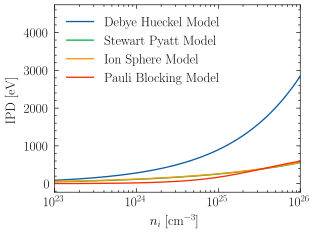
import jax.numpy as jnp
import matplotlib.pyplot as plt

import jaxrts

ureg = jaxrts.ureg

plt.style.use("science")

test_setup = jaxrts.setup.Setup(
    ureg("145°"),
    ureg("5keV"),
    jnp.linspace(4.5, 5.5) * ureg.kiloelectron_volts,
    lambda x: jaxrts.instrument_function.instrument_gaussian(
        x, 1 / ureg.second
    ),
)


fig, ax = plt.subplots()

nes = []

ipds = {"dh": [], "sp": [], "is": [], "pb": []}
keys = ["dh", "sp", "is", "pb"]

md = jnp.logspace(-3, 3, 500)
for m in md:

    test_state = jaxrts.PlasmaState(
        ions=[jaxrts.Element("C")],
        Z_free=jnp.array([5]),
        mass_density=jnp.array([m]) * ureg.gram / ureg.centimeter**3,
        T_e=jnp.array([100]) * ureg.electron_volt / ureg.k_B,
    )

    nes.append(test_state.n_e.m_as(1 / ureg.cc))

    for i, IPDModel in enumerate(
        [
            jaxrts.models.DebyeHueckelIPD(),
            jaxrts.models.StewartPyattIPD(),
            jaxrts.models.IonSphereIPD(),
            jaxrts.models.PauliBlockingIPD(),
        ]
    ):

        IPDModel.model_key = "ipd"
        shift = IPDModel.evaluate(
            plasma_state=test_state, setup=test_setup
        ).m_as(ureg.electron_volt)

        # print(test_state.n_e.m_as(1 / ureg.cc), shift)
        ipds[keys[i]].append(-shift[0])

ax.plot(nes, ipds["dh"], label="Debye Hueckel Model")
ax.plot(nes, ipds["sp"], label="Stewart Pyatt Model")
ax.plot(nes, ipds["is"], label="Ion Sphere Model")
ax.plot(nes, ipds["pb"], label="Pauli Blocking Model")

plt.xscale("log")
# plt.yscale("symlog")
plt.xlabel("$n_i$ [cm$^{-3}$]")
plt.ylabel("IPD [eV]")
plt.legend()
plt.xlim(1e23, 1e26)
# plt.ylim(0.5, 15)
plt.tight_layout()
plt.show()
Total running time of the script: (0 minutes 7.649 seconds)