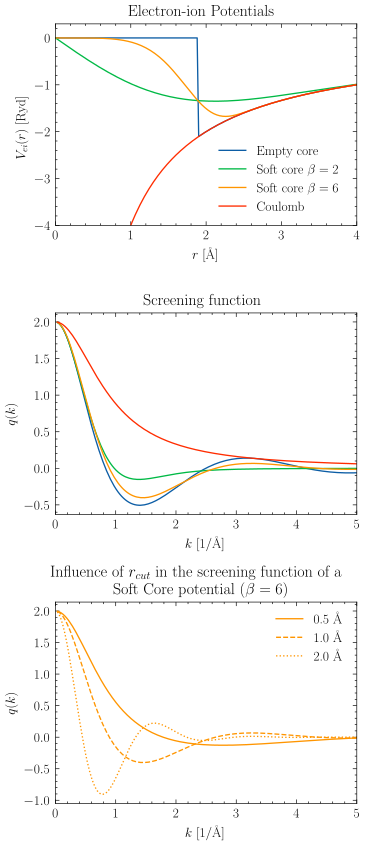
jaxrts.hnc_potentials.SoftCorePotential
- class jaxrts.hnc_potentials.SoftCorePotential(beta: float = 4.0)[source]
Comparable to
EmptyCorePotential, but to circumvent the hard cutoff, rather introduce a soft, exponential cutoff. It’s strength is given by the attributebeta. See [Gericke et al., 2010].We define r_cut in the
jaxrts.PlasmaState.Warning
This potential is only defined for the electron-ion interaction. Hence, it will always and automatically set ~:py:meth:include_electrons to
"SpinAveraged". For the rest, we return a Coulomb-potential – but this is really just to be compatible with the other potentials defined here.Methods
T(plasma_state)The mass_weighted temperature average of a pair, according to [Schwarz et al., 2007].
__init__([beta])alpha(plasma_state)check(plasma_state)Test if the HNCPotential is applicable to the PlasmaState.
citation([style, comment])Return bibliographic information for the Model used.
full_k(plasma_state, k)full_r(plasma_state, r)lambda_ab(plasma_state)long_k(plasma_state, k)long_r(plasma_state, r)mu(plasma_state)The geometric mean of two masses (or reciprocal sum)
prepare(plasma_state, key)q2(plasma_state)This is \(q^2\)!
r_cut(plasma_state)This casts
jaxrts.PlasmaState.ion_core_radiusin the form required to be used with an :py:class:~.HNCPotential`.short_k(plasma_state, k)short_r(plasma_state, r)Attributes
A list of keys where this Potential is adequate for.
A list of bibtex keys.
This is the exponent which gives the steepness of the soft-core's edge
If "SpinAveraged", the electrons are added as the n+1th ion species to the potential.
Examples using
jaxrts.hnc_potentials.SoftCorePotential