Note
Go to the end to download the full example code.
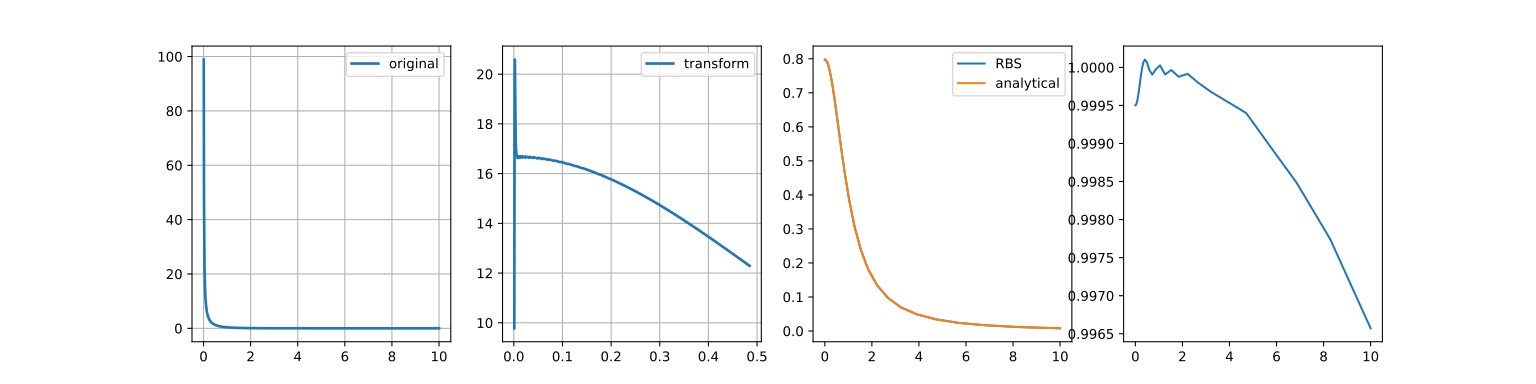
Ogata Fourier transform
/home/runner/work/jaxrts/jaxrts/doc/examples/utils/plot_ogata.py:101: RuntimeWarning: divide by zero encountered in divide
  f = lambda r: 1 / r * (np.exp(-r))  # noqa: E731
/home/runner/work/jaxrts/jaxrts/doc/examples/utils/plot_ogata.py:84: RuntimeWarning: invalid value encountered in multiply
  r, fvals * np.sqrt(rvals), bounds_error=False, fill_value=(np.nan, 0.0)
t= 0.9723012447357178 s
t= 0.007378816604614258 s
t= 0.0062694549560546875 s
t= 0.0055162906646728516 s
t= 0.005601167678833008 s
t= 0.005433082580566406 s
t= 0.005560636520385742 s
t= 0.0054738521575927734 s
t= 0.00539851188659668 s
t= 0.00542902946472168 s
import time
from functools import partial

import hankel
import jax
import jax.numpy as jnp
import matplotlib.pyplot as plt
import numpy as np
import scipy


@jax.jit
def psi(t):
    return t * jnp.tanh(jnp.pi * jnp.sinh(t) / 2)


@jax.jit
def dpsi(t):
    res = (jnp.pi * t * jnp.cosh(t) + jnp.sinh(jnp.pi * jnp.sinh(t))) / (
        1 + jnp.cosh(jnp.pi * jnp.sinh(t))
    )
    return jnp.where(jnp.isnan(res), 1.0, res)


@jax.jit
def bessel_3_2(x):
    return jnp.sqrt(2 / (jnp.pi * x)) * (jnp.sin(x) / x - jnp.cos(x))


@jax.jit
def bessel_0_5(x):
    return jnp.sqrt(2 / (jnp.pi * x)) * jnp.sin(x)


@jax.jit
def bessel_neg0_5(x):
    return jnp.sqrt(2 / (jnp.pi * x)) * jnp.cos(x)


@jax.jit
def bessel_2ndkind_0_5(x):
    return (
        bessel_0_5(x) * jnp.cos(0.5 * jnp.pi) - bessel_neg0_5(x)
    ) / jnp.sin(0.5 * jnp.pi)


def fourier_transform_ogata(k, rvals, fvals, N, h):

    # Get N zeros of Bessel function of order 1/2
    r_k = jnp.arange(1, N + 1)

    y_k = jnp.pi * psi(h * r_k) / h * k

    f_int = jnp.interp(
        y_k / k,
        rvals,
        fvals * jnp.sqrt(rvals),
        left=jnp.nan,
        right=0.0,
        period=None,
    )

    dpsi(h * r_k)

    w_k = bessel_2ndkind_0_5(jnp.pi * r_k) / bessel_3_2(jnp.pi * r_k)

    series_sum = (
        jnp.pi * w_k * f_int * bessel_0_5(y_k) * dpsi(h * r_k) * (y_k / k)
    )

    res = jnp.nansum(series_sum) / jnp.sqrt(k)

    return res


def fourier_transform_hankel(rvals, fvals, N, h):

    f_interp = scipy.interpolate.interp1d(
        r, fvals * np.sqrt(rvals), bounds_error=False, fill_value=(np.nan, 0.0)
    )

    k = np.logspace(-3, 1, 500)

    # Ht = HankelTransform(nu=0.5,N=N,h=h)
    Ft = hankel.SymmetricFourierTransform(ndim=3, N=N, h=h)

    fhat = Ft.transform(f_interp, k, ret_err=False)  # / np.sqrt(k)

    return k, fhat


r = np.linspace(0.0, 10, 1000)  # Define a physical grid
# k = np.logspace(-3,2,100)           # Define a spectral grid

# f = lambda r : np.exp(-r**2 / 2)
f = lambda r: 1 / r * (np.exp(-r))  # noqa: E731
# f_aux = lambda r: f(r)
# Sample Function

k, transform = fourier_transform_hankel(
    r, f(r), 10000, 0.001
)  # Return the transform of f at k.
# f_fft_analy = 1 / k**2 + 1 / (k**2 + 1)

# h_opt = hankel.get_h(
#     f = f, nu=2,
#     K= np.array([1E-3, 1E2]),
#     cls=hankel.SymmetricFourierTransform
# )

fig, ax = plt.subplots(ncols=4, figsize=(16, 4))

ax[0].plot(r, f(r), linewidth=2, label="original")
ax[0].grid(True)
ax[0].legend(loc="best")

pref = 1

# transform =
ax[1].plot(k, transform, linewidth=2, label="transform")
# ax[1].plot(k, f_fft_analy, label = "analytical")

k = np.logspace(-3, 1, 50)
# f_fft_analy = np.exp(-(k)**2/2)
f_fft_analy = jnp.sqrt(2 / jnp.pi) * (1 / k**2) / (k**2 + 1) * k**2


for _i in range(10):
    t0 = time.time()

    f_fft = jax.vmap(
        partial(fourier_transform_ogata, rvals=r, fvals=f(r), N=250, h=0.0001)
    )(k)
    print("t=", time.time() - t0, "s")

# ax[1].plot(r, f_fft_fft, label = "inverse")
ax[2].plot(k, f_fft, label="RBS")
ax[2].plot(k, f_fft_analy, label="analytical")

# dr = r[1] - r[0]
# dk = jnp.pi / (len(r) * dr)
# k_lustig = jnp.pi / r[-1] + jnp.arange(len(r)) * dk
# ax[2].plot(k_lustig, hnc.sinft(r * f(r)) * 4 * jnp.pi / k_lustig)
ax[1].grid(True)
# ax[1].set_xlim(0,0.125)
ax[1].legend(loc="best")
ax[2].legend(loc="best")
# ax[1].set_xlim(0, 100)
# ax[1].set_ylim(0, 1.1)
# ax[0].set_xlim(0, 100)
# ax[0].set_ylim(0, 1.1)

# ax[2].plot(transform / f_fft_analy)
# ax[2].set_ylim(0, 100)
ax[3].plot(k, (f_fft / f_fft_analy))
# print(fourier_transform_ogata(0.1, r, f(r), 1000, 0.005))

plt.show()
Total running time of the script: (0 minutes 1.736 seconds)