Note
Go to the end to download the full example code
Saha equation for hot jupiter materials
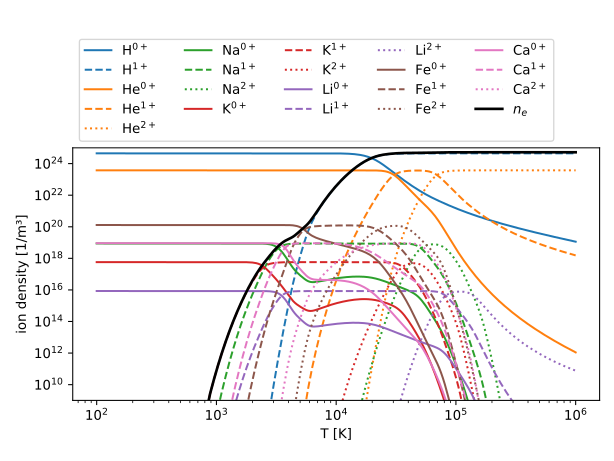
This example showcases the use of the saha equation solver. This example consideres abundances as reported by [Lodders, 2010], and reproduces a plot generated with M. Schöttler’s MALGS programm – which is discussed, e.g. in [Kumar et al., 2021].
import jax.numpy as jnp
import matplotlib.pyplot as plt
import numpy as np

import jaxrts
from jaxrts.saha import solve_saha
from jaxrts.units import ureg

if __name__ == "__main__":
    number_fraction = jnp.array(
        [
            1,
            10 ** (10.925 - 12),
            10 ** (6.29 - 12),
            10 ** (5.11 - 12),
            10 ** (3.28 - 12),
            10 ** (7.46 - 12),
            10 ** (6.31 - 12),
        ]
    )
    number_fraction /= jnp.sum(number_fraction)
    ions = [
        jaxrts.Element("H"),
        jaxrts.Element("He"),
        jaxrts.Element("Na"),
        jaxrts.Element("K"),
        jaxrts.Element("Li"),
        jaxrts.Element("Fe"),
        jaxrts.Element("Ca"),
    ]
    mass_fraction = jaxrts.helpers.mass_from_number_fraction(
        number_fraction, ions
    )

    plasma_state = jaxrts.PlasmaState(
        ions=ions,
        Z_free=jnp.ones_like(mass_fraction),
        mass_density=ureg("1e-5g/cc") * mass_fraction,
        T_e=jnp.array([40]) * ureg.electron_volt / ureg.k_B,
    )
    ion_population = {element.Z: [] for element in ions}
    ion_population["n_free"] = []
    for element in ions:
        for charge in np.arange(element.Z + 1):  # noqa: B007
            ion_population[element.Z].append([])

    Tes = jnp.logspace(2, 6, 250) * ureg.kelvin
    for Te in Tes:
        ion_population["n_free"].append(jnp.array([0.0]))
        sol, ne, _ = solve_saha(
            tuple(plasma_state.ions),
            Te,
            (plasma_state.mass_density / plasma_state.atomic_masses),
        )
        sol = sol.m_as(1 / ureg.meter**3)
        ne = ne.m_as(1 / ureg.meter**3)

        idx = 0

        for element in ions:
            for charge in np.arange(element.Z + 1):
                ion_population[element.Z][charge].append(sol[idx])
                ion_population["n_free"][-1] += charge * sol[idx]
                idx += 1

    fig, ax = plt.subplots()

    ls = ["solid", "dashed", "dotted"]

    for idx, element in enumerate(ions):
        for charge in np.arange(min(element.Z + 1, 3)):
            plt.plot(
                Tes.m_as(ureg.kelvin),
                ion_population[element.Z][charge],
                label=f"{element.symbol}" + "$^{" + f" {charge}+" + "}$",
                color=f"C{idx}",
                ls=ls[charge],
            )

    plt.plot(
        Tes.m_as(ureg.kelvin),
        ion_population["n_free"],
        label="$n_e$",
        color="black",
        lw=2,
    )

    ax.set_xscale("log")
    ax.set_yscale("log")
    ax.set_ylim(1e9, 1e25)
    ax.set_xlabel("T [K]")
    ax.set_ylabel("ion density [1/m³]")
    plt.legend(ncols=5, loc="lower left", bbox_to_anchor=(0.0, 1.0))
    plt.tight_layout()
    plt.show()
Total running time of the script: (0 minutes 35.365 seconds)