Note
Go to the end to download the full example code.
HNC: Multicomponent
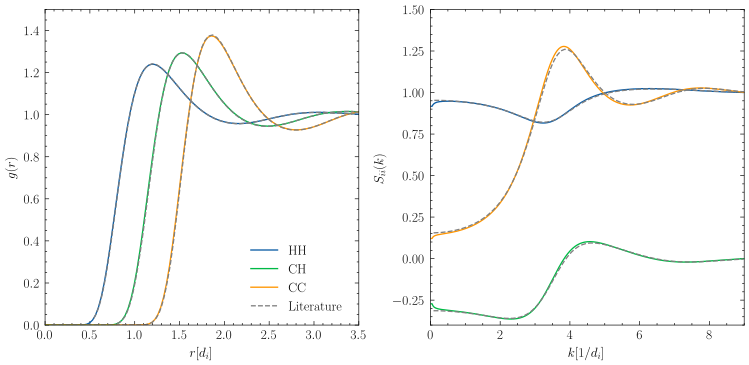
This example reproduces Fig. 4.12 from [Wünsch, 2011], and shows how to use the HNC approximation with different ion species.
from pathlib import Path

import jax.numpy as jnp
import jpu.numpy as jnpu
import matplotlib.pyplot as plt
import numpy as onp

import jaxrts
from jaxrts import hypernetted_chain as hnc
from jaxrts import ureg

plt.style.use("science")

fig, ax = plt.subplots(1, 2, figsize=(8, 4))

# Set up the ionization, density and temperature for individual ion
# species.

state = jaxrts.PlasmaState(
    ions=[jaxrts.Element("H"), jaxrts.Element("C")],
    Z_free=[1, 4],
    mass_density=[
        2.5e23 / ureg.centimeter**3 * jaxrts.Element("H").atomic_mass,
        2.5e23 / ureg.centimeter**3 * jaxrts.Element("C").atomic_mass,
    ],
    T_e=2e4 * ureg.kelvin,
)

pot = 12
r = jnpu.linspace(0.0001 * ureg.angstrom, 200 * ureg.a0, 2**pot)

# We add densities, here. Maybe this is wrong.
d = jnpu.cbrt(
    3 / (4 * jnp.pi * (state.n_i[:, jnp.newaxis] + state.n_i[jnp.newaxis, :]))
)

dr = r[1] - r[0]
dk = jnp.pi / (len(r) * dr)
k = jnp.pi / r[-1] + jnp.arange(len(r)) * dk

# Set the Screening length for the Debye Screening. Verify where this might
# come form.
state["screening length"] = jaxrts.models.ConstantScreeningLength(
    2 / 3 * ureg.a_0
)

Potential = jaxrts.hnc_potentials.DebyeHueckelPotential()

V_s = Potential.short_r(state, r)
V_l_k = Potential.long_k(state, k)

g, niter = hnc.pair_distribution_function_HNC(
    V_s, V_l_k, r, Potential.T(state), state.n_i
)
S_ii = hnc.S_ii_HNC(k, g, state.n_i, r)

ax[0].plot(
    (r / d[0, 0]).m_as(ureg.dimensionless),
    g[0, 0, :].m_as(ureg.dimensionless),
    label="HH",
    color="C0",
)
ax[1].plot(
    (k * d[0, 0]).m_as(ureg.dimensionless),
    S_ii[0, 0, :].m_as(ureg.dimensionless),
    label="HH",
    color="C0",
)
ax[0].plot(
    (r / d[1, 0]).m_as(ureg.dimensionless),
    g[1, 0, :].m_as(ureg.dimensionless),
    label="CH",
    color="C1",
)
ax[1].plot(
    (k * d[0, 0]).m_as(ureg.dimensionless),
    S_ii[1, 0, :].m_as(ureg.dimensionless),
    label="CH",
    color="C1",
)
ax[0].plot(
    (r / d[1, 1]).m_as(ureg.dimensionless),
    g[1, 1, :].m_as(ureg.dimensionless),
    label="CC",
    color="C2",
)
ax[1].plot(
    (k * d[0, 0]).m_as(ureg.dimensionless),
    S_ii[1, 1, :].m_as(ureg.dimensionless),
    label="CC",
    color="C2",
)


# Compare to the literature

try:
    current_folder = Path(__file__).parent
except NameError:
    current_folder = Path.cwd()

for idx, gtype in enumerate(["HH", "CH", "CC"]):
    xlit, glit = onp.genfromtxt(
        current_folder
        / f"../../../tests/data/Wunsch2011/Fig4.12/g_{gtype}.csv",
        unpack=True,
        delimiter=",",
    )
    klit, Slit = onp.genfromtxt(
        current_folder
        / f"../../../tests/data/Wunsch2011/Fig4.12/S_{gtype}.csv",
        unpack=True,
        delimiter=",",
    )
    ax[0].plot(
        xlit,
        glit,
        ls="dashed",
        label="Literature" if idx == 0 else None,
        color="gray",
    )
    ax[1].plot(
        klit,
        Slit,
        ls="dashed",
        label="Literature" if idx == 0 else None,
        color="gray",
    )

ax[0].set_xlabel("$r [d_i]$")
ax[0].set_ylabel("$g(r)$")

ax[0].set_xlim(0, 3.5)
ax[0].set_ylim(0, 1.5)

ax[1].set_xlabel("$k [1/d_i]$")
ax[1].set_ylabel("$S_{ii}(k)$")
ax[1].set_xlim(0, 9)
ax[1].set_ylim(-0.4, 1.5)

ax[0].legend()

plt.tight_layout()
plt.show()
Total running time of the script: (0 minutes 3.736 seconds)