Note
Go to the end to download the full example code.
Showcase of the relavance of including free-bound scattering
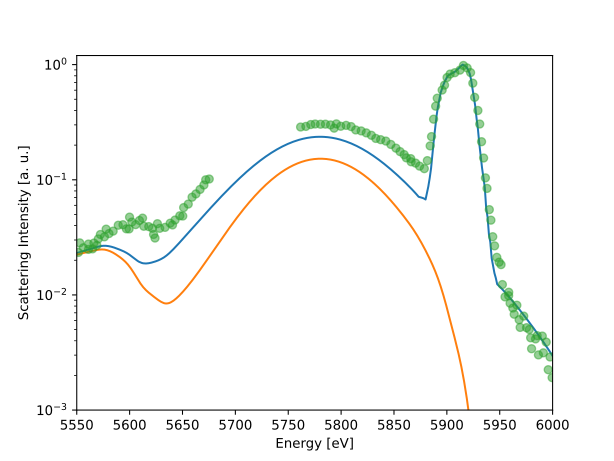
It was suggested by [Böhme et al., 2023] that the evaluation of some experiments need to consider free-bound conditions to fully understand the scattering spectrum. One of the seminal examples of the aforementioned paper is fitting the LCLS data from [Kraus et al., 2018].
Here, we present the stated best-fit results, to show the relevance of these contributions for certain conditions.
/home/runner/work/jaxrts/jaxrts/doc/examples/free_bound/plot_bohme_kraus_relevance_of_bound_free.py:45: DeprecationWarning: `trapz` is deprecated. Use `trapezoid` instead, or one of the numerical integration functions in `scipy.integrate`.
  onp.trapz(PSF_I, (PSF_E / ureg.hbar).m_as(1 / ureg.second)) / ureg.second
from pathlib import Path

import jax.numpy as jnp
import jpu.numpy as jnpu
import matplotlib.pyplot as plt
import numpy as onp
import scienceplots  # noqa: F401

import jaxrts
from jaxrts.hnc_potentials import CoulombPotential
from jaxrts.models import (
    ArbitraryDegeneracyScreeningLength,
    ConstantIPD,
    DetailedBalance,
    OnePotentialHNCIonFeat,
    RPA,
    SchumacherImpulse,
)

ureg = jaxrts.ureg

try:
    current_folder = Path(__file__).parent
except NameError:
    current_folder = Path.cwd()

PSF_E, PSF_I = onp.genfromtxt(
    current_folder / "kraus2018/PSF.csv", unpack=True, delimiter=","
)
PSF_E *= ureg.electron_volt
PSF_I /= (
    onp.trapz(PSF_I, (PSF_E / ureg.hbar).m_as(1 / ureg.second)) / ureg.second
)
central_E = 5909 * ureg.electron_volt


def PSF(omega):
    return jnpu.interp(
        omega, (PSF_E - central_E) / ureg.hbar, PSF_I, left=0, right=0
    )


state = jaxrts.PlasmaState(
    ions=[jaxrts.Element("C")],
    Z_free=jnp.array([1.71]),
    mass_density=([2]) * ureg.gram / ureg.centimeter**3,
    T_e=jnp.array([21.7]) * ureg.electron_volt / ureg.k_B,
    # T_e=jnp.array([16.6]) * ureg.electron_volt / ureg.k_B,
)

setup = jaxrts.setup.Setup(
    ureg("160°"),
    central_E,
    # Make this a little bitter, to avoid the edge effects of the convolution
    jnp.linspace(5450, 6100, 500) * ureg.electron_volt,
    PSF,
)


state["electron-ion Potential"] = CoulombPotential()
state["screening length"] = ArbitraryDegeneracyScreeningLength()
state["ionic scattering"] = OnePotentialHNCIonFeat()
state["ipd"] = ConstantIPD(jnp.array([-24]) * ureg.electron_volt)
state["free-free scattering"] = RPA()
state["bound-free scattering"] = SchumacherImpulse(r_k=1)
state["free-bound scattering"] = DetailedBalance()

probed = state.probe(setup)
norm = jnpu.max(probed)
plt.plot(
    (setup.measured_energy).m_as(ureg.electron_volt),
    (probed / norm).m_as(ureg.dimensionless),
)
plt.plot(
    (setup.measured_energy).m_as(ureg.electron_volt),
    (state.evaluate("bound-free scattering", setup) / norm).m_as(
        ureg.dimensionless
    ),
)

Data_E, Data_I = onp.genfromtxt(
    current_folder / "kraus2018/data.csv", unpack=True, delimiter=","
)
plt.plot(Data_E, Data_I, ls="none", marker="o", alpha=0.5)
plt.yscale("log")

plt.xlabel("Energy [eV]")
plt.ylabel("Scattering Intensity [a. u.]")
plt.xlim(5550, 6000)
plt.ylim(1e-3, 1.2)
plt.show()
Total running time of the script: (0 minutes 15.037 seconds)